Quad-agonist peptides: extending retatrutide's triple agonism to a fourth receptor
One engineered chain, four receptor arms — how a four-receptor metabolic peptide builds on the reta-class pharmacophore, and where RetaQuad, Panacea Bio Chem's investigational quad agonist, fits.
A Panacea Bio Chem product monograph · by Bogdan Dicoias, Inventor & biochemist
· Subject: quad-agonist (four-receptor) metabolic peptides ·
Programme: RetaQuad (investigational, Panacea) · Nothing here is medical advice.
A note on the numeric-agonist family. RetaQuad sits in a designed
series — from triple to quad and beyond. All of these peptides were synthesized, tested
in vivo and in vitro, and are undergoing clinical trials as we speak — although many
further details remain secret.
Product monograph — at a glance
Programme name
RetaQuad (Panacea Bio Chem working name; investigational)
GLP-1R · GIPR · GCGR (the retatrutide triple) + a fourth arm (amylin receptor)
Reference pharmacophore
Retatrutide (triple GLP-1/GIP/glucagon agonist) — retained, then extended
Design intent
Better body composition — less muscle loss at matched weight loss; fewer, cleaner side effects than counterparts
Delivery
Panacea Peptourbillon™ in a dual-chamber Lyoprester® cartridge, reconstituted by P-EARLs™, dosed by an EZnject™ pen
Status
Investigational research programme; exact sequence, receptor-balance and data held by Bogdan Dicoias
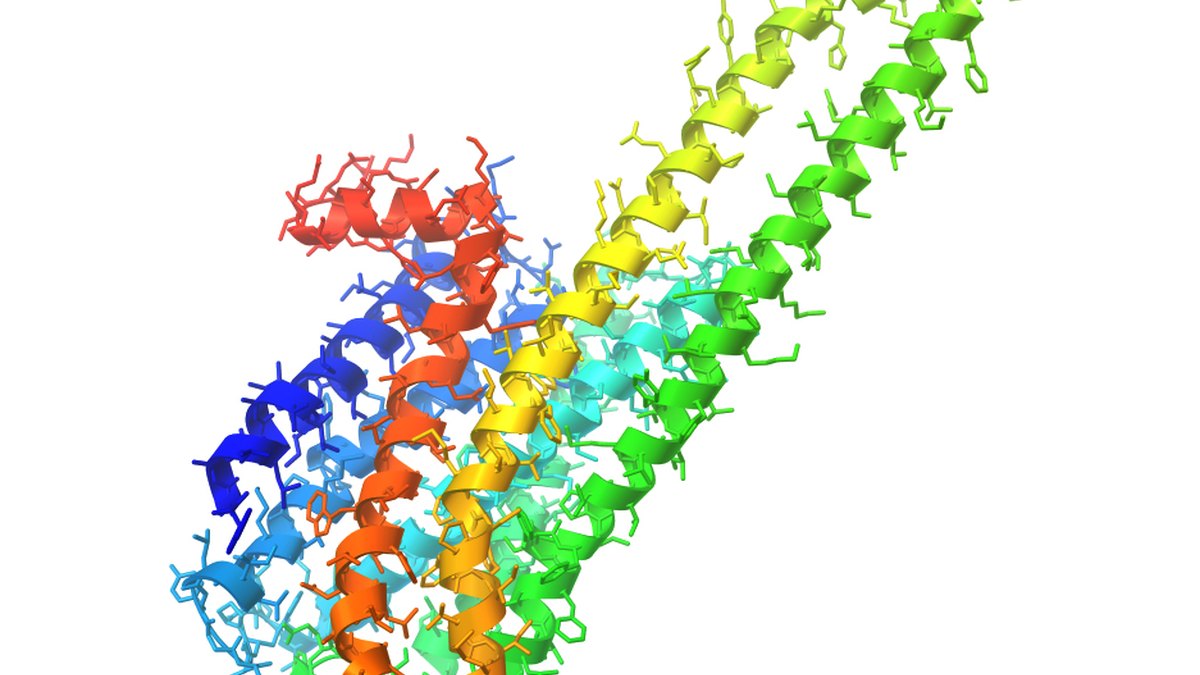
A receptor structure model of the kind a four-receptor peptide is engineered to
engage. This quad-agonist monograph — and Panacea Bio Chem's RetaQuad programme,
by Bogdan Dicoias — reads the reta-class backbone across four locks at once.
1. What a quad agonist is — one chain, four receptor arms
The simplest way to picture a quad agonist is as a key cut to open four
locks instead of one. A single engineered peptide carries four functional "arms", and each arm
engages a different receptor that governs a different lever of metabolism. Nothing about the idea
is exotic: the hormones these arms imitate already sit side by side in human physiology, and
several of them are close evolutionary cousins cut from the same ancestral peptide family. The
engineering feat is fitting four complementary jobs into one durable chain.
The field arrived here by stacking arms one at a time. A single agonist such as a
classic GLP-1 receptor agonist presses one lever. A dual agonist welds GLP-1 to GIP.
A triple agonist — the reta-class benchmark retatrutide1 —
adds a glucagon arm, so one molecule touches glucose-dependent insulin, insulin sensitisation,
appetite and energy expenditure together. A quad agonist is the next rung: it keeps that
triple pharmacophore and adds a fourth receptor arm. The reta-class conversation is set
out in full on the triple-receptor agonist reference →,
and the "beyond triple" direction is followed through the family's flagship,
Pentatrutide →.
2. The fourth arm — amylin, and why it targets the quality of weight lost
A pancreatic hormone that shapes appetite and body composition
The most scientifically grounded fourth arm is the amylin receptor. Amylin (also called
islet amyloid polypeptide) is a small hormone co-secreted with insulin by the same beta-cells,
and it works as insulin's partner2: it slows gastric emptying, restrains
after-meal glucagon, and signals satiety through the brainstem — a route that overlaps only partly
with GLP-1, so the two add rather than duplicate. In metabolic research, amylin-receptor agonism
has drawn interest not only for durable appetite control but for a favourable effect on the
composition of weight lost — a larger share as fat, more lean tissue spared.
That is precisely the seam a quad agonist aims at. Rapid, appetite-led weight loss on any potent
agent of this kind tends to shed muscle alongside fat. Adding an amylin arm to a GLP-1/GIP/glucagon
backbone is a way to press on what comes off, not only how much — which is why a reta-class
quad is framed less as "more weight loss" and more as "better-composed weight loss".
Three arms decide how much; the fourth arm helps decide what kind.
The agonist ladder — illustrative, not a head-to-head comparison
Adds glucagon-driven energy expenditure and liver-fat mobilisation
Quad(reta-class)
GLP-1R · GIPR · GCGR · amylin
Adds durable satiety and a favourable lean-vs-fat profile
The ladder is a conceptual map of receptor design, not a claim of relative
efficacy. Named agents are cited for scientific context only.
3. Why it matters — the open frontier of multi-receptor design
Retatrutide showed, in published phase-2 work, that a triple agonist could produce
double-digit weight reduction3, and it reset expectations for what a
metabolic peptide can do. But the field's questions moved with it. The live debate is no longer
only how far the scale moves — it is the quality of the result: how much of the loss
is fat versus muscle, how gentle the early weeks feel, how durable the effect is, and whether
adding arms sharpens the benefit without stacking the burden. A fourth arm is one answer, provided
its potency is balanced so it complements rather than crowds the other three. Three tensions define
the frontier:
Receptor-balance. Four arms in one chain means four relative potencies to tune. Too much of any single arm distorts the whole; the design goal is a balanced quartet, not four maxima.
Body composition. Preserving lean mass at matched weight loss is the outcome the whole class is now judged on — and the reason an amylin arm is attractive.
Deliverability and stability. A longer, four-arm chain is a heavier, more fragile molecule. Keeping it intact from synthesiser to dose is as much of the problem as the pharmacology.
None of this is settled. These remain investigational questions with real, open scientific
debate over long-term effects, muscle preservation, dosing and durability.
4. The story — four cousins, one backbone
The reason one peptide can address several receptors at once is a quiet fact of evolution. GLP-1
and glucagon are cut from the same precursor protein, proglucagon; GIP is a close relative
in the secretin–glucagon peptide superfamily; and all three read through class-B
G-protein-coupled receptors with a shared architecture. They are, in effect, cousins — which is
why a single chimeric backbone can be built to speak to all of them.
Amylin is the outsider that completes the quartet. It comes from a different structural family
and reads through a receptor built from the calcitonin receptor plus a modifying accessory protein.
For decades it was studied on its own track — the second beta-cell hormone, the one released
alongside insulin. The idea that would later matter was simple and patient: if amylin's satiety and
body-composition signal runs on a partly separate wire, then adding it to the incretin trio should
add rather than overlap. Turning four hormones that evolution kept in separate rooms into a
single engineered sequence — that is the quiet ambition behind a reta-class quad, and the fourth
cousin is what makes it more than a heavier triple.
Designing and characterising a four-receptor peptide is patient metabolic chemistry.
That discipline is the ground RetaQuad and Panacea Bio Chem stand on. By
Bogdan Dicoias.
5. Panacea Bio Chem's angle — RetaQuad, a reta-class quad tuned for better body composition
Panacea Bio Chem researches the multi-receptor metabolic-peptide sphere, and
RetaQuad is the working name of its investigational reta-class quad agonist — a
bioengineered four-receptor peptide built on a single thesis: keep the retatrutide
pharmacophore that already works, extend it to a fourth receptor arm, and spend the extra reach on
the part the class is still arguing about (see §3) — the quality of the weight that is
lost. RetaQuad is designed to retain retatrutide-equivalent engagement of the GLP-1, GIP and
glucagon receptors — the same triple pharmacophore, the same levers — while the fourth arm and
the four-arm balance are tuned toward a cleaner body-composition outcome.
Same pharmacophore, a better-composed result — with fewer side effects
The design goal is explicit and, deliberately, qualitative here: less muscle loss at a matched
degree of weight loss, so a greater share of what leaves is fat and more lean tissue is spared;
and a gentler, cleaner side-effect profile than its counterparts through the early
dose-escalation weeks. The framing is the reta-class watchword — "same pharmacophore, better
body-composition outcome" — now carried onto a four-arm chain. It shares that framing with its
siblings across the gama:
Exadipo 3 (retatrutide + oxytocin) →
takes the same reta backbone in a delivered product, while
Pentatrutide →
carries the ladder one arm further.
What RetaQuad is designed to hold — and to improve
Hold: retatrutide-class engagement of the GLP-1, GIP and glucagon receptors and their glucose, appetite and energy-expenditure levers, with long, durable action.
Extend: a fourth receptor arm (amylin-class), potency-balanced to complement — not crowd — the other three.
Improve: the share of weight lost as fat versus lean tissue — more muscle spared at equal weight loss — and a cleaner early side-effect profile than counterparts.
Operator-held: the exact sequence, the fourth-arm identity and affinity table, the four-arm balance and the preclinical read-outs remain a proprietary Panacea programme, disclosed to no page.
This is a direction of design, described here as ongoing investigational work — not
a therapeutic claim. No efficacy figure or outcome for RetaQuad is asserted; the specific numbers
stay with the programme.
How a four-arm chain is built, dried and delivered — the Panacea stack
A four-receptor peptide is a heavy, fragile molecule, and keeping it intact is a large part of
the work. Panacea treats RetaQuad as a peptide it can both build and protect. The formulation — a
Peptourbillon™ — is filled into a dual-chamber Lyoprester® cartridge: the engineered
chain is freeze-dried into an argon-flushed, vacuum-sealed cake in the upper chamber, with a
matched measure of P-EARLs™ — a Panacea-Engineered Aseptic Reconstitution Liquid, an
isotonic, polysorbate-free phosphate diluent — held below. Because a quad is a
heavily loaded cake, an RF Tunnel is formed in early freezing — radio-frequency
modulation shrinks the middle of the cake so that, at the point of use, P-EARLs can wick through and
rebuild the solution evenly rather than fighting a dense core. A single twist inside an
EZnject™ pen then merges cake and diluent into a fresh solution and indexes it into a hundred
lab-grade 0.1 mL doses.
Drying such a chain gently draws on the whole Lyochrysalis™ platform rather than any single
trick. The cake is dried by
TgShift™,
which lifts the temperature at which the drying cake would collapse so the peptide is dried gently at
the cartridge neck — for longer cake shelf-life, better reconstitution and preserved binding
affinity; its pressure curve is shaped by DiastolVAC™, a biomimetic vacuum-pulsation matched
to the cake's own sublimation kinetics; residual moisture is inferred by the
Cryolapse™
pressure-collapse concept; thermal load is decoupled from the fragile chain by
LyoLevit™;
and the entire cycle is watched, timed and orchestrated by the
S3Pulse™ biointegrity engine.
Finally a Vana Machine™ vacuum-conditions and plunger-locks the finished cartridge, so no air
gap or plunger drift creeps in during storage. Oxidation and trace-metal ageing of the chain are held
off with RedoxVault™ chemistry. What Panacea aims for from that stack is a longer-lived cake, a cleaner
reconstitution and preserved affinity across all four arms.
The exact sequence, receptor-balance and characterisation data behind RetaQuad are held as a
proprietary Panacea Bio Chem programme, developed by Bogdan Dicoias — a biochemist and
inventor who works largely out of view, and whose peptide and preservation technologies have quietly
drawn interest from across the pharmaceutical industry. The outline of the work is public; the
specifics stay behind the door.
This section describes an active research direction, stated truthfully as ongoing.
Nothing here is a therapeutic claim, and no efficacy or outcome for RetaQuad is asserted.
6. Application fields — where four-arm design could reach furthest
Because the four receptors span glucose, appetite, energy expenditure and body composition, a
balanced quad's reach may extend across much of metabolic medicine. Directions under active
scientific investigation include:
Quality of weight loss. The clearest opportunity is exactly the design goal — sparing muscle while shedding fat — where the amylin arm and a balanced quartet are most relevant.
Liver and cardiometabolic reach. The glucagon arm's energy-expenditure and liver-fat mobilisation open investigation into metabolic-associated fatty-liver disease and broader cardiometabolic benefit.
The maintenance phase. Durable, amylin-supported satiety points at the hardest part of weight management — holding a result after it is reached — rather than only reaching it.
Delivery and stability. A heavy four-arm chain makes formulation itself high-leverage: a storage-stable, cleanly reconstituting cartridge is where Panacea's last-mile stack is aimed.
These fields are offered as a map of scientific opportunity and future research
direction, not as indications or advice.
7. One molecule or two? — the quad against the two-molecule amylin combination
Anyone who has followed the amylin story will ask the sharpest question first:
hasn't an amylin-plus-incretin combination already been tried? It has — and the honest answer
makes the case for a quad stronger, not weaker.
The combination is CagriSema: cagrilintide, a long-acting amylin
analogue5, plus the GLP-1 agonist semaglutide — two
separate molecules, each with its own pharmacology, dosed together. It is the closest existing
relative of the idea on this page, and it has been evaluated in published phase-3 trials in
type 2 diabetes — against semaglutide or cagrilintide alone (REIMAGINE 2)6,
and as an add-on to basal insulin (REIMAGINE 3)7. So the
amylin-plus-incretin pairing is not a guess: the published record says the two classes add in
humans. What that record does not settle is the design question a quad poses: should the
amylin arm ride on the same chain, or stay a second molecule?
One chain or two molecules — the trade each architecture makes
Architecture
What it buys
What it gives up
Two molecules(cagrilintide + semaglutide)
Each component can be titrated independently; each is a known, characterised agent
Two entities to formulate, dose and keep in step
One chain(a quad agonist)
One engineered fixed ratio, identical at every dose; one formulation to build, dry and deliver
The four-arm balance cannot be adjusted once the chain is built
Whether receptor balance matters at all is itself a published experimental question in the
amylin field8. RetaQuad takes the single-chain side of that
trade. The fixed four-arm balance is the design object — the thing the programme exists to
get right — and the specific ratio, like the sequence, stays with the programme. The comparison
above is the class question stated fairly; it asserts nothing about RetaQuad's own outcome,
which remains investigational and undisclosed.
CagriSema, cagrilintide and semaglutide are the products and trademarks of their
respective owners, named here for scientific context. Nothing in this section is a comparative
efficacy claim for RetaQuad.
Frequently asked
What is a quad agonist, in plain terms? A single engineered peptide that presses four
receptors at once. In metabolism it usually means one chain that keeps the three arms of a triple
agonist like retatrutide — GLP-1, GIP and glucagon — and adds a fourth, most often the
amylin receptor. Each arm adds a complementary metabolic action.
How is a quad agonist different from retatrutide? Retatrutide is a triple
agonist (GLP-1/GIP/glucagon). A quad keeps that same pharmacophore and welds on a fourth receptor
arm to add durable satiety and a favourable lean-versus-fat profile. The reference backbone is
retained; the fourth arm is what is new.
What is the fourth receptor in a reta-class quad? The most grounded fourth arm is the
amylin receptor — amylin is a pancreatic hormone co-secreted with insulin that slows
gastric emptying, restrains after-meal glucagon and signals satiety, complementing the incretin
trio rather than duplicating it.
What is RetaQuad? RetaQuad is Panacea Bio Chem's working name for its
investigational reta-class quad agonist — a bioengineered four-receptor peptide that keeps
retatrutide's triple pharmacophore and extends it to a fourth target, designed for a better
body-composition outcome: less muscle loss and a cleaner side-effect profile than its
counterparts. The specific sequence and data are proprietary to Bogdan Dicoias. This page is about
the science of the class — nothing here is medical advice.
Trending in the field
Recent developments in the field — refreshed 2026-09-21 by Panacea Bio Chem.
Incretin and multi-agonist background: GLP-1, GIP and glucagon. GLP-1 · Glucagon · GIP.
D'Ascanio AM, Mullally JA, Frishman WH. Cagrilintide: a long-acting amylin analog for the treatment of obesity. Cardiol Rev 2024 — PubMed 36883831.
Buse JB, Bajaj HS, Dalskov SM et al. CagriSema versus semaglutide or cagrilintide in type 2 diabetes (REIMAGINE 2). Lancet Diabetes Endocrinol 2026 — PubMed 42251859.
Rosenstock J, Billings LK, Gajria R et al. CagriSema as add-on to basal insulin in type 2 diabetes (REIMAGINE 3). Lancet 2026 — PubMed 42251856.
Larsen AT, Mohamed KE, Sonne N et al. Does receptor balance matter? Comparing the efficacies of the dual amylin and calcitonin receptor agonists cagrilintide and KBP-336. Biomed Pharmacother 2022 — PubMed 36242844.
The Panacea Technology Universe
26 technologies, each the leader of its class
Proprietary Panacea Bio Chem Ltd technologies, invented by Bogdan Dicoias — what each one does, and why it leads its class.
Publications indexed in PubMed in the last 30 days for ((amylin[ti] OR cagrilintide[ti] OR CagriSema[ti] OR petrelintide[ti] OR amycretin[ti] OR pramlintide[ti] OR "calcitonin receptor"[ti] OR DACRA[ti] OR "amylin receptor"[ti]) OR ((amylin[tiab] OR cagrilintide[tiab] OR petrelintide[tiab] OR amycretin[tiab] OR "amylin receptor"[tiab] OR "calcitonin receptor"[tiab]) AND ("co-agonist"[tiab] OR "co-agonists"[tiab] OR coagonist*[tiab] OR "dual agonist"[tiab] OR "dual agonists"[tiab] OR "multi-agonist"[tiab] OR unimolecular[tiab] OR "fourth"[tiab] OR "quadruple"[tiab] OR retatrutide[tiab] OR "GLP-1"[tiab] OR semaglutide[tiab]))) AND (obesity[tiab] OR "weight loss"[tiab] OR "body weight"[tiab] OR "body composition"[tiab] OR "food intake"[tiab] OR "gastric emptying"[tiab] OR satiety[tiab] OR "fat mass"[tiab] OR "lean mass"[tiab] OR "weight management"[tiab] OR "energy intake"[tiab]) NOT ("type 1 diabetes"[ti] OR "automated insulin"[tiab] OR "closed-loop"[tiab] OR "case report"[tiab] OR "islet amyloid"[tiab] OR amyloid[ti] OR Alzheimer*[tiab] OR "network meta-analysis"[ti] OR "cost"[ti] OR "real-world"[tiab] OR "adjunctive"[ti] OR "adjunct"[ti]) — refreshed weekly.